John's ham radio blog
  • Blog
    • SOTA
    • GMA
    • DLFF
    • Portabel
    • Ausrüstung
    • Recht und Urteile
    • Veranstaltungen
    • QSL
    • Software
    • US Amateurfunk Lizenz
    • Sonstiges
    • Satellite
  • DK9JC / AK9JC
    • Mein QRZ.com
  • Awards
    • SOTA
    • GMA
    • FT8 DMC
  • My gear
  • My Logs

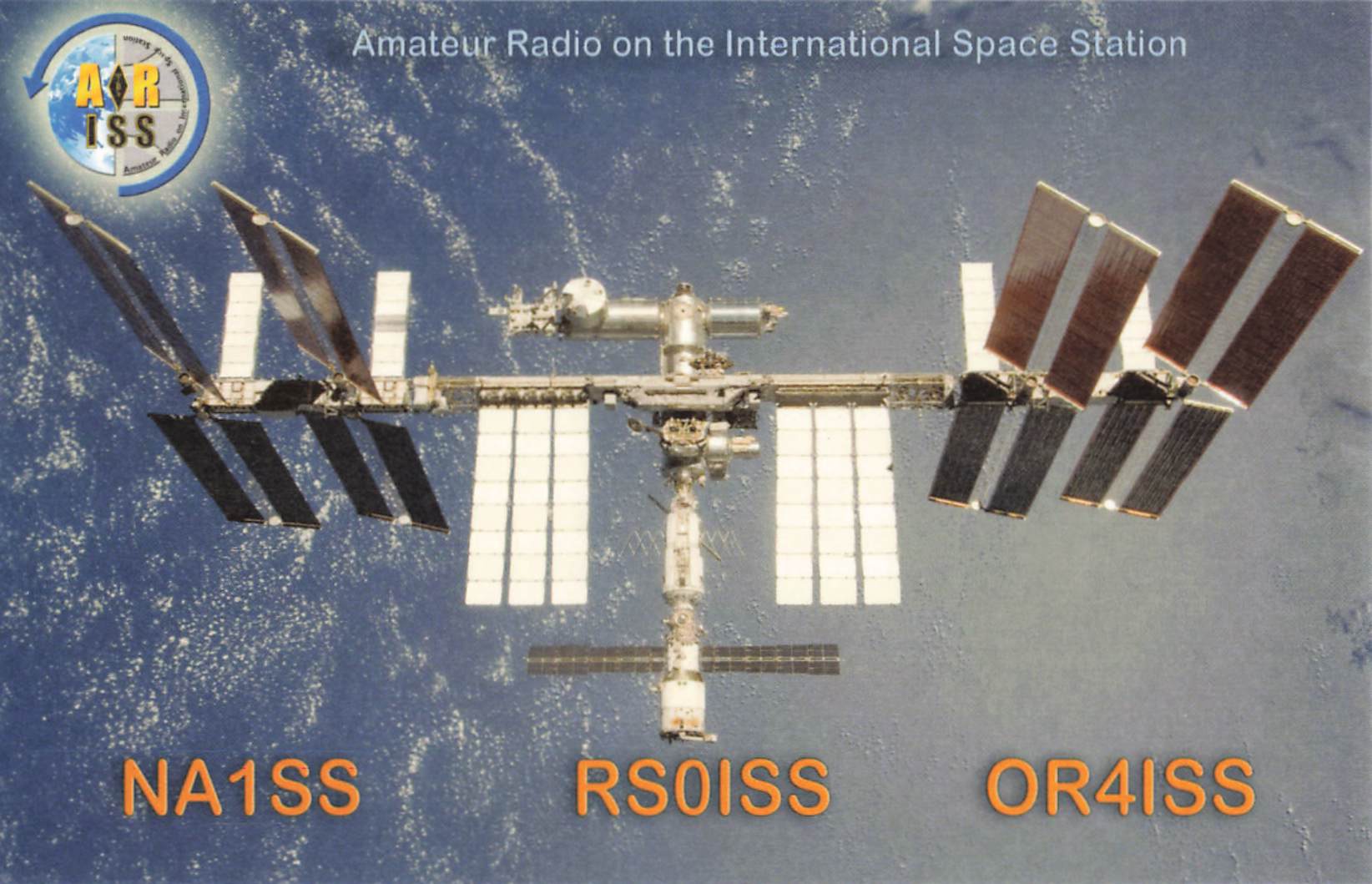
July, 23 2022: Contact with Kjell Lindgren NA1SS aboard the International Space Station (ISS)
Details
John, DK9JC & AK9JC
Satellite
04 August 2022
NA1SS confirms DK9JC QSO

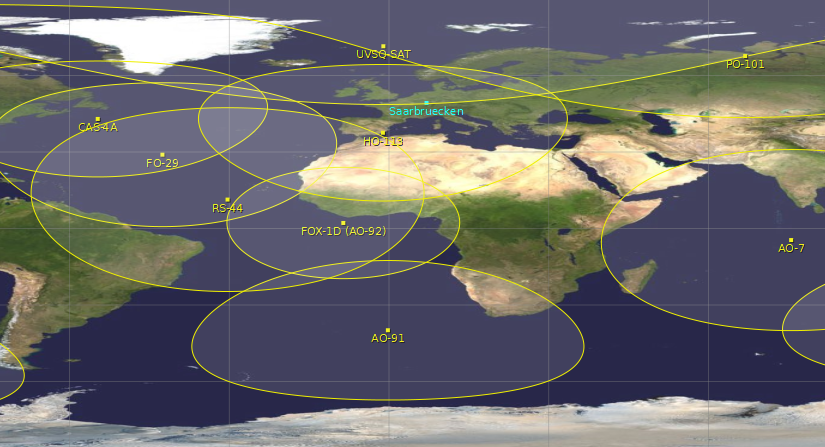
NASA astronaut Kjell Lindgren brought joy to many radio amateurs in recent weeks when he contacted them directly from the space station via the ISS repeater, giving some a QSO with NA1SS. In the past three to four years, there were mostly no connections with the crews outside of school contacts. On Friday 22 July, NA1SS was heard over Europe in the evening, allowing European radio amateurs to make a QSO. The following day, Joshua, DL3JOP, was able to make a QSO with NA1SS at 18:08 UTC. Motivated by this, John, DK9JC, also set off with his portable equipment to hear his call confirmed by Kjell on the next overflight 1.5 h later (21:45 h local). Anyone who also wants to try their luck should have a 2 m and 70 cm directional antenna and a full duplex transceiver system. The repeater's frequencies and CTCSS can be found on the ARISS website.
Read more: July, 23 2022: Contact with Kjell Lindgren NA1SS aboard the International Space Station (ISS)

FT-817 FT-818 8x7 doppler correction with Gpredict

Details
John, DK9JC & AK9JC
Satellite
06 March 2022
FT-817 FT-818 with Gpredict

I recently bought an FT-818 to accompany my FT-817 to work portably on linear satellites. In this article I will show you how to set up Gpredict properly.

At home I use Gpredict for doppler correction under Windows. Gpredict is free software, but requires Hamlib/rigctl(d) for cat control. Hamlib is not self-explanatory because it is not a ready-made software. You have to create the individual parameters yourself. The necessary information can be found in Hamlib's Gitlab.

So you have to create a command for each transceiver. Since I use 2 transceivers for full-duplex, I have to create 2 commands.

The most important thing is to find out the ID of your transceiver. The list can be found here: https://github.com/Hamlib/Hamlib/wiki/Supported-Radios

For me it is ID 1020 for Yaesu FT-817 and 1041 for Yaesu FT-818.

FT-817 and FT-818 have slight differences in the CAT commands. Therefore there are 2 profiles. (This is also the reason why the current version of SatPC32 currently does not work with the FT-818. Only the FT-817 is supported there.)

Read more: FT-817 FT-818 8x7 doppler correction with Gpredict

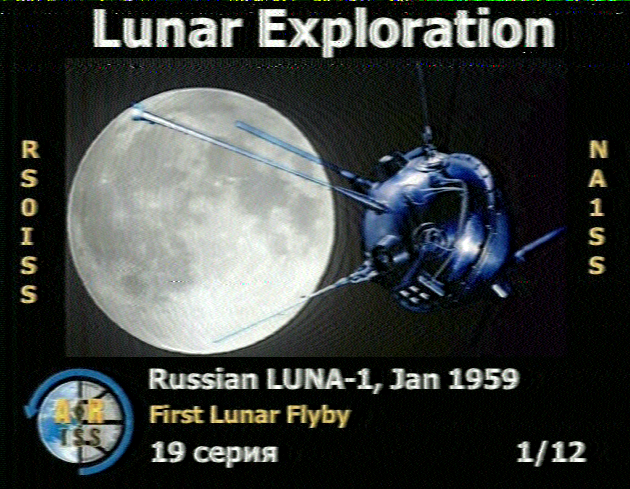
Receiving ISS SSTV images - Expedition 66 - ARISS Series 19 Lunar Exploration

Details
John, DK9JC & AK9JC
Satellite
30 December 2021
Expedition 66 - ARISS Series 19 Lunar Exploration

After I kept seeing new SSTV images sent from the ISS on Twitter, I thought I'd give it a try too. Since I've been doing a lot of radio via FM amateur radio satellites lately anyway, I have a small 4 element LogPer directional antenna at the window anyway.

The free open source Android software "Robot36" was often recommended as software. I was very surprised when it gave a very clear picture even without a cable between my handheld radio and my mobile phone. In Robot36, however, you should select the mode manually and not leave it to chance whether "auto" works. Currently PD120 was used, which is what ARISS announced (see original message below).

I was able to achieve very good results with my Yaesu FT2 and FT4. With every pass I could decode at least 1 complete picture. The antenna was always an Anjo 4 ele logper held out of the window on a 2m wooden broomstick and the ISS was tracked via the Android app "ISS Detector".

Read more: Receiving ISS SSTV images - Expedition 66 - ARISS Series 19 Lunar Exploration
Page 2 of 2
  • Start
  • Prev
  • 1
  • 2
  • Next
  • End
  • amsat
  • IRF530
  • Bündelfunk
  • WSPR
  • IC-2730
  • System Fusion
  • LEO
  • Friedrichshafen
  • BOS
  • BF-888S
  • Raspberry
  • 60m
  • DG1YFE
  • Pofung
  • recycling
  • Widderbierg
  • ASCOM
  • 18650
  • io-117
  • DST

Beliebteste Beiträge

  • Magnetic Loop (Magnetantenne) selber bauen (DIY magnetic loop antenna)
  • Baofeng BF-888S Test und Programmierung (Pofung)
  • MX-P50M 50W HF Power Amplifier für FT-817 und KX-3
  • DIY Kits 70W SSB linear HF Power Amplifier FT-817 KX2 KX3
  • Ascom SE540 BOS-Funkgerät - Umbau auf Amateurfunk
  • Li-Ion battery pack (18650s) for the FT-817 and KX2 and comparision on RC Li-Po and LiFePo4 packs
  • US Extra-Class bestanden
  • Amateurfunk Klasse E (CEPT-Novice) – Erfahrungen nach knapp einem Jahr
  • Mag Loop Magnetic Loop DIY with trashed 26 inch bicycle rim
  • APRS Kabel für Baofeng und APRSdroid selbst gebaut
  • RSS
  • Links
  • Login
  • Impressum
  • Datenschutzerklärung

Twitter Social Icon RSS Social Icon

Follow me on Twitter Social Icon RSS Social Icon

Amateurfunk-Blog.de / DK9JC.de 2014 - 2026

Bootstrap is a front-end framework of Twitter, Inc. Code licensed under MIT License. Font Awesome font licensed under SIL OFL 1.1.