John's ham radio blog
  • Blog
    • SOTA
    • GMA
    • DLFF
    • Portabel
    • Ausrüstung
    • Recht und Urteile
    • Veranstaltungen
    • QSL
    • Software
    • US Amateurfunk Lizenz
    • Sonstiges
    • Satellite
  • DK9JC / AK9JC
    • Mein QRZ.com
  • Awards
    • SOTA
    • GMA
    • FT8 DMC
  • My gear
  • My Logs

Baofeng UV-82L Test

Details
John, DK9JC & AK9JC
Equipment
16 January 2017
Baofeng UV-82L Test

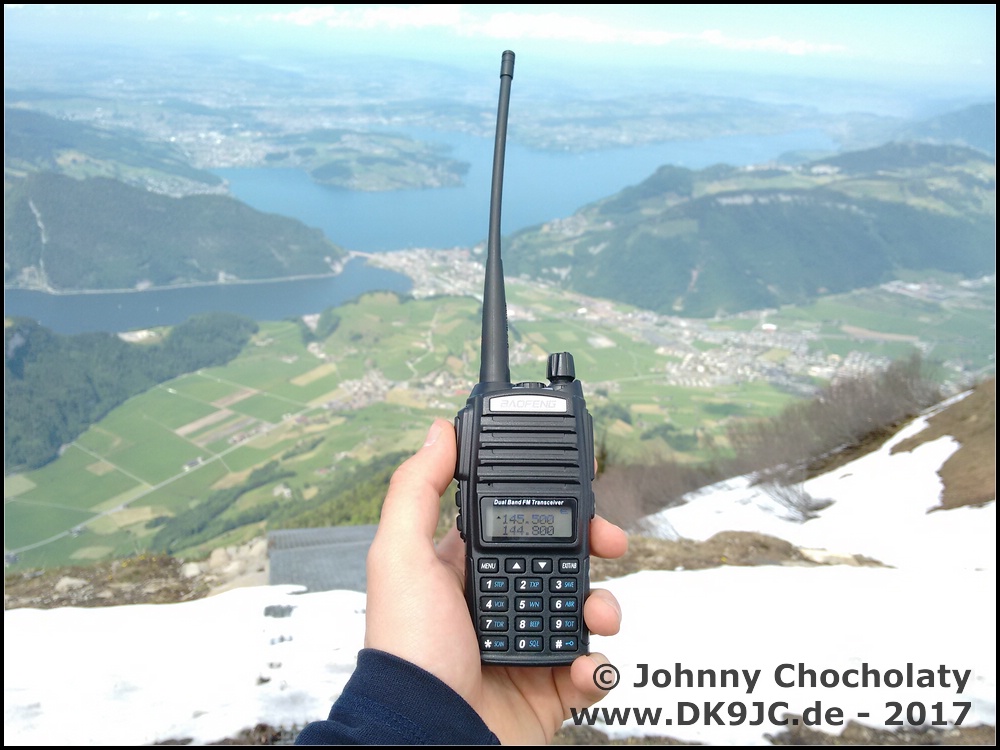
Ich habe mir vor ziemlich genau 1,5 Jahren ein Baofeng UV-82L gekauft. Es handelt sich dabei um ein billiges China Handy, welches aber recht gut und robust aussieht. Gekostet hat es ca. 30 Euro bei Amazon. Eigentlich kann man für das Geld ja nichts erwarten, aber ich war schon mit meinem Baofeng UV-5R und BF-888S sehr zufrieden. Klar meine Yaesu Geräte sind irgendwie hochwertiger vom "look-and-feel" - aber der Preis ist doch unglaublich. Ich schiebe diesen Beitrag schon über ein Jahr vor mir her. Heute schreibe ich einfach mal das Grundgerüst und nach und nach werde ich Inhalte einbinden. Ähnlich wie bei meinem Beitrag über das BF-888S, welcher nun schon über 15.000 Hits und viele Kommentare hat. Grundsätzlich gilt erst einmal das Gleiche wie bei dem BF-888S. Der Betrieb "out-of-the-box" ist in Deutschland erst einmal für alle illegal. Es ist absolut verboten, sich zwei Stück zu bestellen und los zu funken. Der Grund ist, dass die programmierten Frequenzen nicht für die Allgemeingeit freigegeben sind.
Read more: Baofeng UV-82L Test

Raspberry Pi 10mW WSRP beacon and 20m QRP bandpass filter

Details
John, DK9JC & AK9JC
Equipment
18 December 2016
QRP Labs 20m Bandpass Filter

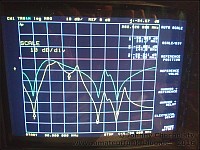
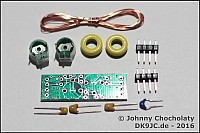
Some days ago I received a parcel from my friend Silvio, DM9KS. There was a 20m QRP band-pass filter from QRP Labs inside. I then built the kit as it was there anyway. I did not wind the torroids very accurate, but I have an insertion loss of 2.1 db only on 20m and I have -53db attenuation on 40m and -32db on 15m. I would say great piece of kit! Silvio also told me, that some guys use their Raspberry Pis as a 10mW WSPR beacon. So I connected the filter to my Pi to see what happens.

Read more: Raspberry Pi 10mW WSRP beacon and 20m QRP bandpass filter

Ascom SE540 BOS-Funkgerät - Umbau auf Amateurfunk

Details
John, DK9JC & AK9JC
Equipment
20 November 2016
Ascom SE540 BOS-Funkgerät

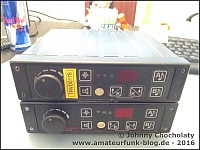
In diesem Beitrag geht es um den Umbau von Ascom SE540 BOS-Funkgeräten. Es war Michael, DB7MM der mich auf die Idee gebracht hat, 2m BOS Funkgeräte von Ascom so zu umzubauen, dass sich diese für den Amateurfunk einsetzen lassen. Er selbst hat das schon einige Male gemacht und gab mir daher eine „vorsichtige“ Empfehlung. Ich habe dann bei eBay ein Angebot gefunden. Ein Händler wollte inkl. Versand nur 30 Euro pro Gerät haben. Ich bestellte also gleich 2 und baute sie dieses Wochenende um. Das Ascom SE540 ist ein Behördenfunkgerät und dementsprechend massiv ausgelegt. Die Verarbeitung und Haptik ist ausgezeichnet. Man bekommt mit dem SE540 ein sehr wartungsfreundliches Gerät, das eine gute Dämpfung von Außerbandsignalen hat.

Read more: Ascom SE540 BOS-Funkgerät - Umbau auf Amateurfunk

Nagoya NA-24 antenna repair

Details
John, DK9JC & AK9JC
Equipment
14 November 2016
Nagoya NA-24 antenna repair

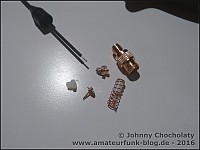
Some weeks ago I bought a new -ultra flexible- Nagoya NA-24 antenna for my Baofeng UV-82L. When I used the Nagoya antenna for the very first time I received almost nothing. I first thought that I (again) bought a counterfeit Nagoya antenna and put this one in the drawer. Just yesterday I found it again and became a bit annoyed as I wasted another 20 bucks here. I decided to open the NA-24 with a pair of two big pliers. The black cover had an internal thread and was fixed with some superglue. With some force I was able to disassemble the whole connector and could inspect all the antenna parts. I found out that the flexible radiator was not soldered on the socket of the antenna so it had no electrical connection to my Baofeng radio. I soldered the radiator to the antenna socket and put everything back together again. I tested the NA-24 antenna on the local repeater while I walked on the streets in the city. It worked flawless.

Read more: Nagoya NA-24 antenna repair

RTL-SDR bandpass-filter and DIY coax-notch filters

Details
John, DK9JC & AK9JC
Equipment
01 November 2016
Tuning the front-end filters

Some days ago I decided to install an APRS RX-only iGate here in my apartment. The iGate simply takes the APRS signals from the air and forward them to the internet. I live almost in the center of the city and I have a free sight over the buildings. Good preconditions for a „fill-in“ iGate I thought. I had a Raspberry Pi and a cheap RTL-SDR dongle (DVB-T stick) for this purpose. Sounded like an easy job first but I received nothing within the next 12 hours. I knew that something must be wrong. In this project I learned more on designing HF-filter than on Linux and Raspbian, what actually was my aim at the beginning of this project. In this blog post I will show you, how I successfully dealt with massive QRM from two 100kw and 2 50kw radio transmitters.

Read more: RTL-SDR bandpass-filter and DIY coax-notch filters

FT-817 CAT-interface with built-in USB soundcard

Details
John, DK9JC & AK9JC
Equipment
24 October 2016
FT-817 interface for digimodes

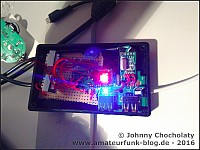
Some time ago I bought one of these small and light 2 in 1 tablets with Windows 10. The device was very small in size but the battery lasts very long. With only 1,7kg the weight was not too high for my portable ops. I did not take it into the field yet. The reason was simple: The tablet has one USB-port only. I need one port for the USB cat lead and another one for the USB-soundcard to connect my existing PC-interface made by Alan, M0AQC. After a long search on the internet I did not find a simple FT-817 interface with one USB lead, CAT-control and built-in soundcard. So what did I do? I built an interface that meets my requirements by myself.

Read more: FT-817 CAT-interface with built-in USB soundcard

More Articles …

  1. FT-817 smartphone interface for PSKdroid and APRSdroid
  2. Li-Ion battery pack (18650s) for the FT-817 and KX2 and comparision on RC Li-Po and LiFePo4 packs
  3. SOTAbeams Mountain EFHW Tuner 40-17m kit
  4. Ultralight QRP endfed antenna (0,14mm²/26AWG)
  5. MX-P50M 50W HF PA for FT-817 and KX-3: How to use the amplifier on datamodes
  6. Leichter Portabel-Dipol aus der Schrottkiste
  7. Tuner für endgespeiste Drähte - EFHW
  8. MX-P50M 50W HF Power Amplifier für FT-817 und KX-3
  9. Garmin eTrex 10 Test: GPS-Handgerät - damit finde ich zum Gipfel
  10. APRS Kabel für Baofeng und APRSdroid selbst gebaut
  11. Handy im Feld laden: Ideal für SOTA, GMA und Co.
  12. FT-817 DC-Buchse defekt: Umbau auf Powerpoles
  13. DYC-8x7 Dynamikkompressor Funkamateur FT-817
  14. Test: ATX-1080 Antenne (WiMo, u.a.) - MFJ-1899T
  15. Baofeng BF-888S Test und Programmierung (Pofung)
Page 4 of 7
  • Start
  • Prev
  • 1
  • 2
  • 3
  • 4
  • 5
  • 6
  • 7
  • Next
  • End
  • 097
  • DB0EW
  • RTL
  • io-117
  • ISS
  • IOTA
  • SE540
  • DA/SR
  • Android
  • DR60SAL
  • Pixie
  • Ausrüstung
  • Betriebsfunk
  • PSKdroid
  • Li-Po
  • QSL
  • FT-891
  • Genehmigung
  • Pofung
  • Hochsimmer

Beliebteste Beiträge

  • Magnetic Loop (Magnetantenne) selber bauen (DIY magnetic loop antenna)
  • Baofeng BF-888S Test und Programmierung (Pofung)
  • MX-P50M 50W HF Power Amplifier für FT-817 und KX-3
  • DIY Kits 70W SSB linear HF Power Amplifier FT-817 KX2 KX3
  • Ascom SE540 BOS-Funkgerät - Umbau auf Amateurfunk
  • Li-Ion battery pack (18650s) for the FT-817 and KX2 and comparision on RC Li-Po and LiFePo4 packs
  • US Extra-Class bestanden
  • Amateurfunk Klasse E (CEPT-Novice) – Erfahrungen nach knapp einem Jahr
  • Mag Loop Magnetic Loop DIY with trashed 26 inch bicycle rim
  • APRS Kabel für Baofeng und APRSdroid selbst gebaut
  • RSS
  • Links
  • Login
  • Impressum
  • Datenschutzerklärung

Twitter Social Icon RSS Social Icon

Follow me on Twitter Social Icon RSS Social Icon

Amateurfunk-Blog.de / DK9JC.de 2014 - 2026

Bootstrap is a front-end framework of Twitter, Inc. Code licensed under MIT License. Font Awesome font licensed under SIL OFL 1.1.